
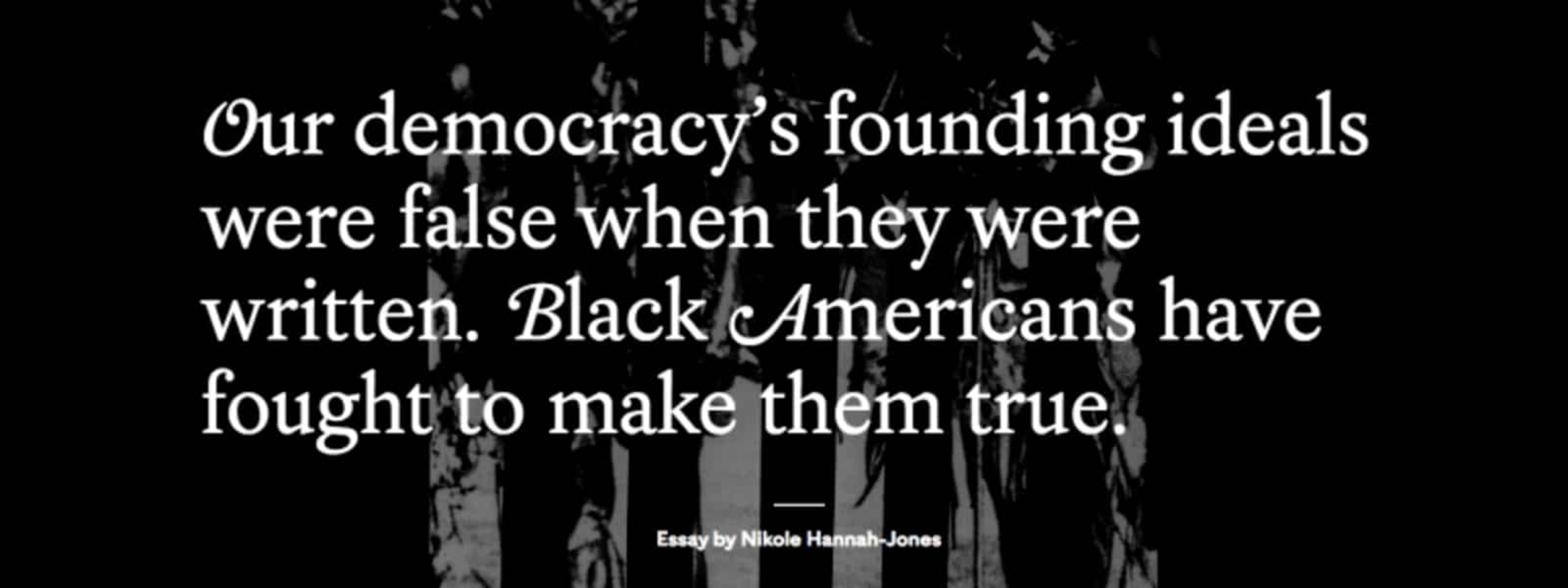
“What if America understood, finally, that we have never been the problem but the solution?” Nikole Hannah Jones (The Idea of America)
While I struggle with the idea that a single month is an appropriate way to celebrate something as fundamental and significant as racial or gender identity, I do appreciate the opportunity to pause and reflect.
For me, Black History Month has opened a much richer understanding of the contributions and contributors of Black people in the United States. This was an education that I did not receive until I sought it out myself. My white, suburban upbringing in the 1970s and 80s had no history books that captured the pivotal moments and stories that I later discovered. Through the years, my curiosity led me to explore the writings of Dr. King, Malcolm X, Zora Neale Hurston, Frederick Douglass, and, more recently, Nikole Hannah-Jones. It was their stories and oratory that opened a historical kaleidoscope of brutality, survival, perseverance, and prosperity; the story of Black life in America from 1619 until today.
I disciplined myself to maintain a clear perspective, to avoid the false equivocation and white-washing (every pun intended) of the complex trajectory of slavery and its current scars as somehow being less relevant today given the success of people like Oprah Winfrey and David Steward. I rejected the false narrative that just because we could point to examples of Black people accomplishing great things meant that the consequences of slavery no longer impacted or limited possibility.
I am reminded that W.E.B. Dubois was born into a free family, but his grandfather had been a slave; and that Mary McLeod Bethune who was appointed director of African American Affairs by U.S. President Franklin D. Roosevelt, had been born to former slaves during the turbulent Reconstruction Era. These are examples of people who have worked diligently throughout their lives to create change for the future based on the history of the past. The narrative that frames the history and context for each of these individuals was intrinsically linked to and impacted by the consequences of slavery.
So, too, is the story of the Declaration of Independence, a document written predominantly by Thomas Jefferson, a slave owner. The Declaration espouses that “all men are created equal,” yet in practice, it gave no rights to Black men, women, or non-land-owning white men. It wasn’t until 1868, nearly 100 years after its writing, when the 14th Amendment was passed which stated that “all people born or naturalized in the United States, including formerly enslaved people” are citizens, guaranteed equal protection under the law. This Amendment changed the interpretation of whom the Declaration was declaring to include or recognize.
These stories are important because they impart to us that as a nation, we can learn through the teaching of history. They are not only evidence of our past but also offer beacons of possibility and a hopeful future to strive toward. Young and old alike need to understand that the greatness of this country rests in its ability to reckon with its gravest sins, recognize the lessons, and commit to a future that is better for all.
This Black History Month, in the year 2023, 404 years after the historical marker of slavery was penned, we are witnessing the dismantling of Black history and the hope it engenders. Laws are being passed that criminalize teaching the history of slavery. This effort to blot out the ancestral experience of millions of Black Americans and to refuse its truth-telling to students degrades the history of all Americans.
The history of Black Americans is the history of all Americans. There is no world where the sins of slavery can be disconnected from the sinners who perpetrated it, nor from the world that permitted and benefited from its legalization for more than 200 years. We can never hope to rise above the shame until we first admit that it happened and learn from it. If our children are the future, we must empower them with the knowledge of the past so they can lead us toward that dream and the famed “mountaintop.”